

We Got Your Rhythm
Hacker Detection Without False Positive Alerts
Cybersecurity from
Solutions for Universities and CollegesSolutions for Universities and Colleges
Worldwide novel security approach
Employee Knowledge Is Key
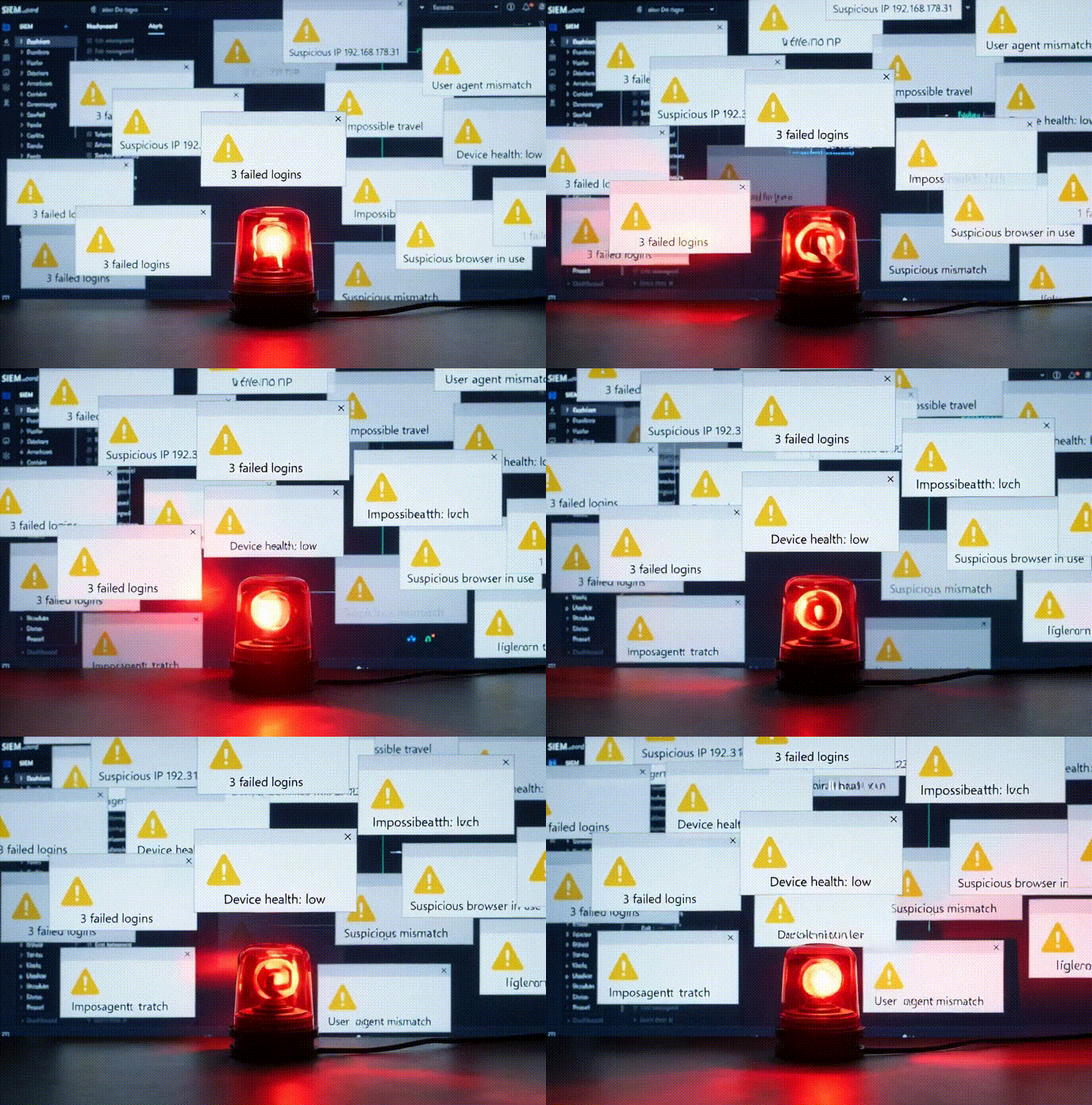
The biggest drawback of modern SIEMs is their high number of false positive alerts.
Why is that? It's because today’s SIEMs lack the most important factor for improving detection quality - which is: the contextual knowledge held by corporate employees.
Unlike SOC teams, employees carry crucial contextual insights in their minds, often in qualitative form, allowing them to judge alerts more accurately than automated systems in SOCs.
We translate these qualitative insights, i.e. the employee's knowledge, into quantitative data. Figuratively speaking, we capture the rhythm of your IT infrastructure. And we do this more accurately than this has ever been done before.
Why Today's Cybersec Software Gets It All Wrong
From a mathematical perspective, today’s SIEMs rely on Bayesian inference-based risk scores to detect attackers. This topic is rarely discussed because Bayesian methods require well-defined probability distributions to work — but SIEMs do not meet these assumptions. For this reason alone, their reliability should be questioned.
We won’t dive deeper into theory here. Instead, we present the solution: deterministic workflows and variables grounded in frequentist principles. That is: Hacker alerts with a 100 % reliability. And no, AI cannot fix this fundamental issue with/of Bayesian approaches.
Worldwide novel security approach
Employee Knowledge Is Key
The biggest drawback of modern SIEMs is their high number of false positive alerts.
Why is that? It's because today’s SIEMs lack the most important factor for improving detection quality - which is: the contextual knowledge held by corporate employees.
Unlike SOC teams, employees carry crucial contextual insights in their minds, often in qualitative form, allowing them to judge alerts more accurately than automated systems in SOCs.
We translate these qualitative insights, i.e. the employee's knowledge, into quantitative data. Figuratively speaking, we capture the rhythm of your IT infrastructure. And we do this more accurately than this has ever been done before.
Why Today's Cybersec Software Gets It All Wrong
From a mathematical perspective, today’s SIEMs rely on Bayesian inference-based risk scores to detect attackers. This topic is rarely discussed because Bayesian methods require well-defined probability distributions to work — but SIEMs do not meet these assumptions. For this reason alone, their reliability should be questioned.
We won’t dive deeper into theory here. Instead, we present the solution: deterministic workflows and variables grounded in frequentist principles. That is: Hacker alerts with a 100 % reliability. And no, AI cannot fix this fundamental issue with/of Bayesian approaches.
Tech Offer
Our Objective is to Create Unique Hacking Alerts Without Any False Positives
All modern SIEMs lack the most important data, which is: The context knowledge of employees. We at CSSO solutions are the first to tackle the most important problem of SIEMs and prove to the world that alerts without false-positives are possible.
Have you ever wondered why all SOCs have huge problems assessing alerts – while an employee without any cybersec background can easily differentiate if an alert is real or not? The reason is that employees have way more data resp. variables in their head than SIEMs. Employees know which software they are using on a day-to-day basis, which mails they are writing to who and so on. This is sort of the real context knowledge that employees have but the machine lacks.
This is also data resp. variables – but we're speaking of those data, which can not be automatically generated via algos based on log-files. For example, it is your Employees who know which software they are using on a daily basis, which mails they are writing to who and so on.
We're Also Great a Fit for Legacy SIEMs
"Never change a running system." And with Team CSSO on board, there'll be no need for that. We can massively improve your existing system and help you reduce costs at the same time. Thus, no need to force yourself to embrace novel SIEM technologies which obviously would trigger even higher costs and friction. It's plug and play for you and our alerts are not in need of a huge processing power, large databases and so on.
But if it is that simple - Why has nobody else so far ensued our approach? The reason is that our alerts are based on an extensive, rigid approach that takes many hours of our employees. With Western salaries of cybersec staff, our approach is financially very expensive. Therefore, this idea partly derives from Cameroon/Western Africa where it is financially still possible to have an extensive implementation. Selling algos is also a scalable business when it comes down to finding investors for your business. In reality though, human staff is still very much needed to reach excellent alert assessment.

Why Open Source Hacker Detection Wins
SOC-SIEM for SMEs
Open-Source SOC-SIEM for SMEs: Next to our novel technology, we also offer pragmatic open-source SIEMs.
Flexible & Scalable:
Deployable from single servers to large clusters — whether on-premises, hybrid, or cloud-native.
Cost Control:
No licensing costs per event or host. Investment goes into operations, expertise, and meaningful integrations.
Transparency & Community:
Open, customizable rules with active community support.
Comprehensive Security Tools:
Log collection, host intrusion detection, vulnerability and configuration assessments, malware and anomaly detection, cloud auditing, container/Kubernetes integration, dashboards, and APIs — everything's included.
We are one of the few openly speaking out that SMEs are mostly forced by legislators to implement SIEMs. We stand critical on forcing enterprises and organizations to high spendings. However, we can instead offer an affordable state-of-the-art implementation in accordance with ISO 27001, BSI IT-Grundschutz or other norms.
Why Open Source Hacker Detection Wins
SOC-SIEM for SMEs
Open-Source SOC-SIEM for SMEs: Next to our novel technology, we also offer pragmatic open-source SIEMs.
Flexible & Scalable:
Deployable from single servers to large clusters — whether on-premises, hybrid, or cloud-native.
Cost Control:
No licensing costs per event or host. Investment goes into operations, expertise, and meaningful integrations.
Transparency & Community:
Open, customizable rules with active community support.
Comprehensive Security Tools:
Log collection, host intrusion detection, vulnerability and configuration assessments, malware and anomaly detection, cloud auditing, container/Kubernetes integration, dashboards, and APIs — everything's included.
We are one of the few openly speaking out that SMEs are mostly forced by legislators to implement SIEMs. We stand critical on forcing enterprises and organizations to high spendings. However, we can instead offer an affordable state-of-the-art implementation in accordance with ISO 27001, BSI IT-Grundschutz or other norms.

Stay Tuned
Subscribe to Our Newsletter

Stay Tuned
Subscribe to Our Newsletter